
Cut the cost of waste without a new tax
Your cost per resident compared with similar areas, what French law requires, and costed scenarios to bring the bill down: composting, collection frequency, treatment plant, recycling centres.
Comparison
How much does our waste cost per resident?
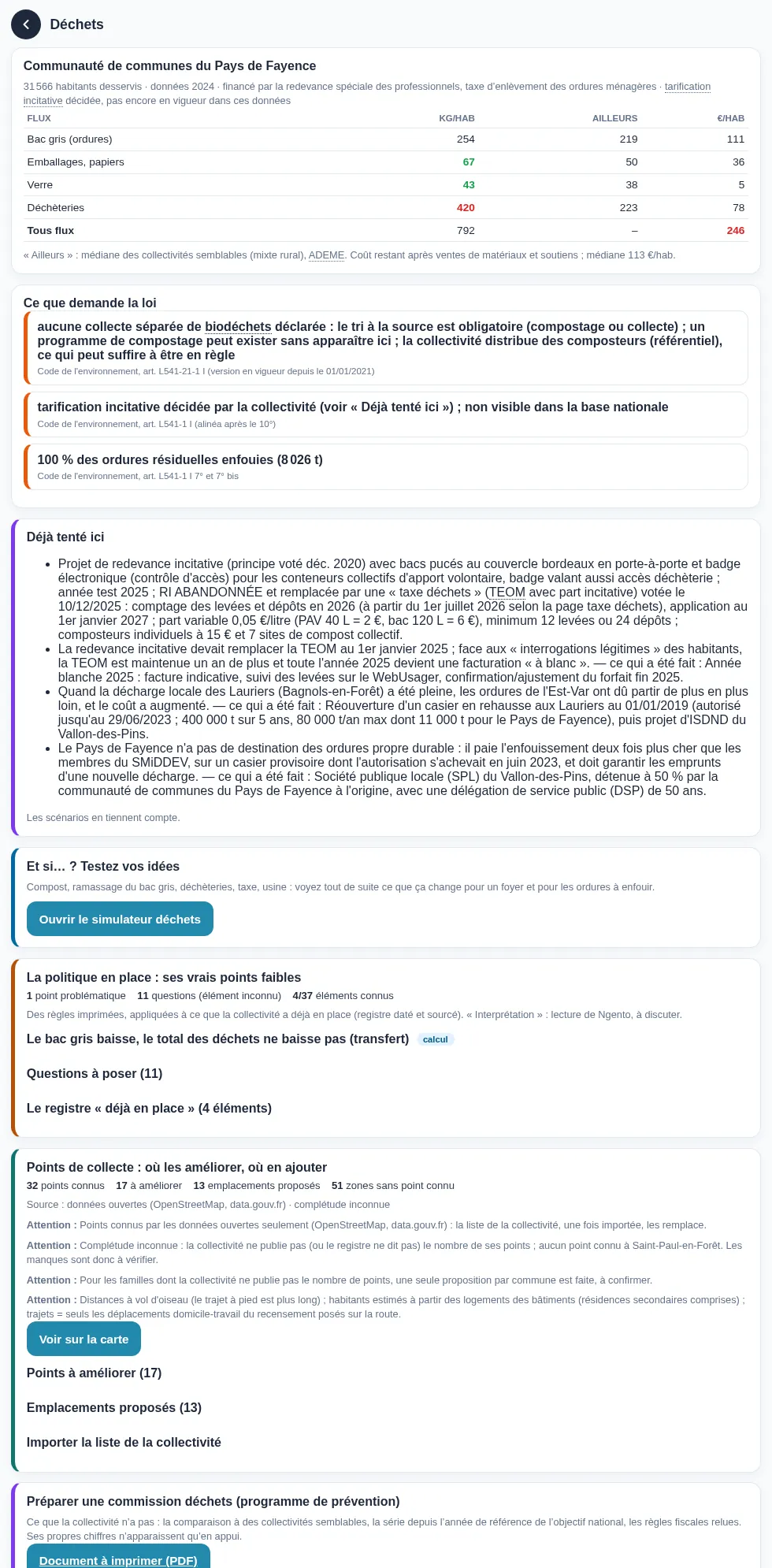
Territoire reads ADEME data (the SINOE database) for the authority that manages your waste: how it is funded, tonnages by stream (residual bin, packaging, glass, recycling centres), costs, where waste goes, facilities. It compares them with ADEME's published medians for authorities of the same type (rural, mixed, urban, tourist).
Compliance
Are we compliant?
The tool checks what the law sets, with the article cited: separate sorting of bio-waste (compulsory since 31 December 2023, Environment Code, art. L541-21-1), share of waste sent to landfill, the pay-as-you-throw target (a national target, not an obligation).
Scenarios
Which organisation brings the cost down?
Each scenario is costed, with its investment, annual effect, pros, cons, assumptions and examples from other authorities:
- no change (and what the planned rise in landfill taxes will cost);
- bio-waste sorted at source: home composters or, where they have already been handed out, measuring their use and supporting households, without buying more;
- residual bin collected every other week, once composting is in place;
- sending waste to the nearest energy-recovery plant instead of landfill, transport included (IGN roads): net cost compared (treatment price, transport, tax avoided), kept only if it lowers the cost, otherwise left “to be studied”;
- recycling centres: fewer tonnes without asking more of residents (trade users at the right price, garden-waste shredding, reuse);
- an incentive element within the existing tax (not a new tax), shown separately and never counted in the total; if the authority has already decided on it, the tool says so and helps make it work.
The recommendation combines the scenarios that reduce cost without creating a tax and without asking more of residents. Anything that would burden them (badges, quotas, a lower no-charge allowance, badge-operated drop-off points, higher charges) stays visible as a rejected option, with the reason. The tool also suggests collection times that disrupt traffic least, based on bus times, accidents and schools.
Simulator
A simulator to test your choices
The waste simulator asks simple questions: what if some households composted, from “nobody” to “6 households in 10”? What if the residual bin were collected every other week? What if trade users paid for what they bring to recycling centres? What if waste went to the energy-recovery plant instead of landfill? It adds up the choices and shows, before and after: tonnes, service cost, landfill tax from 2026 to 2030 and the average effect per household. A lever already in place, or irrelevant for you, is greyed out with the reason.
On the Pays de Fayence example, the “no new tax” choices give about €54 less per household per year, on average: each household's tax depends on its home, and second homes and businesses pay too.
Committee
Preparing a waste committee meeting
For a committee or a local waste-prevention programme, Territoire prepares a document that does not repeat your own figures: it brings what is often missing in the meeting.
- comparison with similar areas: same type of authority in the ADEME database, population from half to twice yours, medians and never averages;
- the trend since 2010, the reference year of the national reduction target;
- shifts: residual waste falling while recycling-centre or bulky waste rises is not a reduction;
- taxes, incentive or punitive: landfill tax from 2026 to 2030, incentive element, management fees, share of spending covered by the tax;
- why the bill is rising, item by item;
- questions to ask in the meeting, each with its figure, and the legal articles checked.
The document downloads as a PDF from the Waste view, or as a report topic. Interpretations are flagged as such, for discussion.
Related blocks
Day to day: the waste service
Territoire informs the strategy: costs, law, scenarios. For the day-to-day service, two other Ngento blocks take over. Moins jeter (Waste less), for residents: collection days, full bins, shredding, reuse area. Gestion des déchets (waste management), for the service: checks on bin lifts and recycling centre visits, simulation of charging schedules and checks on the collection contractor's invoice.
Limits
Estimates, not a quote
ADEME reference costs date from 2022; landfill and incineration taxes are those in force in 2026. A value missing from the reference data shows as “to be costed”, never as zero. Savings are orders of magnitude, to be confirmed with your treatment syndicate and your contracts.
Frequently asked questions
Your questions
Is separate bio-waste sorting compulsory for French municipalities?
Can costs come down without raising the waste collection tax?
Is pay-as-you-throw compulsory?
Can residual waste be collected every other week?
Can it help prepare a waste committee meeting?
Where do the costs come from?
Demo
Try the demo
An online demo opens an example assessment, its map, its simulators, an example project and example events. It is reserved for French public bodies: municipalities, inter-municipal bodies, departments, regions, syndicates, public establishments and State services.
Enter your work email address: it is checked against the official directory of the French administration, then you receive a code by email. Access lasts one month. The demo is read-only: nothing you do in it is saved. The tool is in French.