
Skip to content
Ngento Territoire
Territoire, by Ngento

An assessment of your area, sourced, mapped and costed

Enter French municipalities, a postcode or an inter-municipal body. Territoire reads public data (census, roads, road accidents, bus timetables, natural hazards, water, waste, municipal finances…), cross-checks it, and gives you ranked issues, an action plan with cost ranges, a map and a PDF report to present. The tool is in French and covers France only.

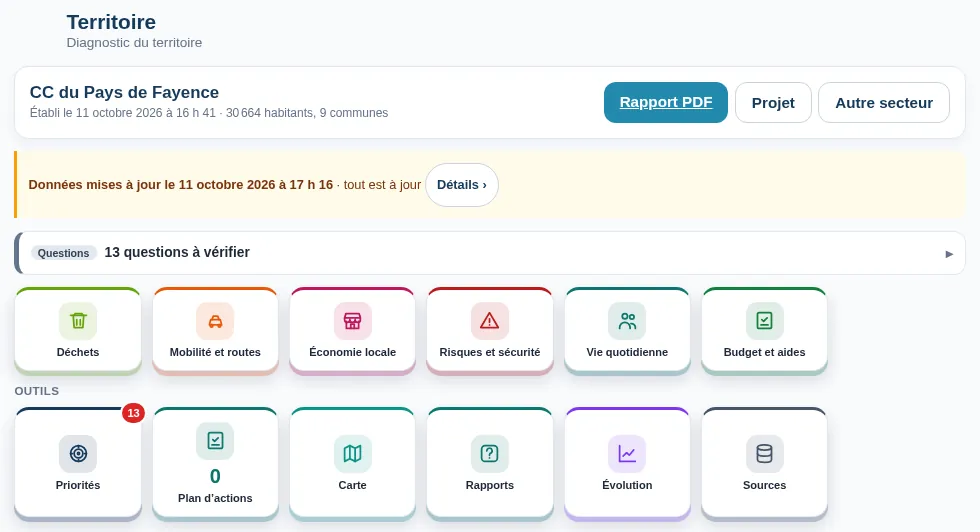
A Territoire assessment on a computer: “CC du Pays de Fayence”, produced on 11 October 2026, 30,664 residents, 9 municipalities; the PDF report, Project and Other area buttons; the note “data updated on 11 October 2026 · all up to date”; “13 questions to check”; six themes (Waste, Mobility and roads, Local economy, Risks and safety, Daily life, Budget and funding) and the tools Priorities (13), Action plan, Map, Reports, Change over time and Sources.
Screenshot of Territoire (the tool is in French).

The problem

The data exists. The time to cross-check it does not.

What a municipality needs to know to make decisions is almost always public: how residents get to work, where accidents happen, which roads are exposed to floods, how much waste costs per resident. But these figures are spread across dozens of producers (INSEE, IGN, ministries, ADEME…), in different formats, and a small team has no time to bring them together.

Territoire does that work for an area you choose, and states plainly what public data cannot tell you.

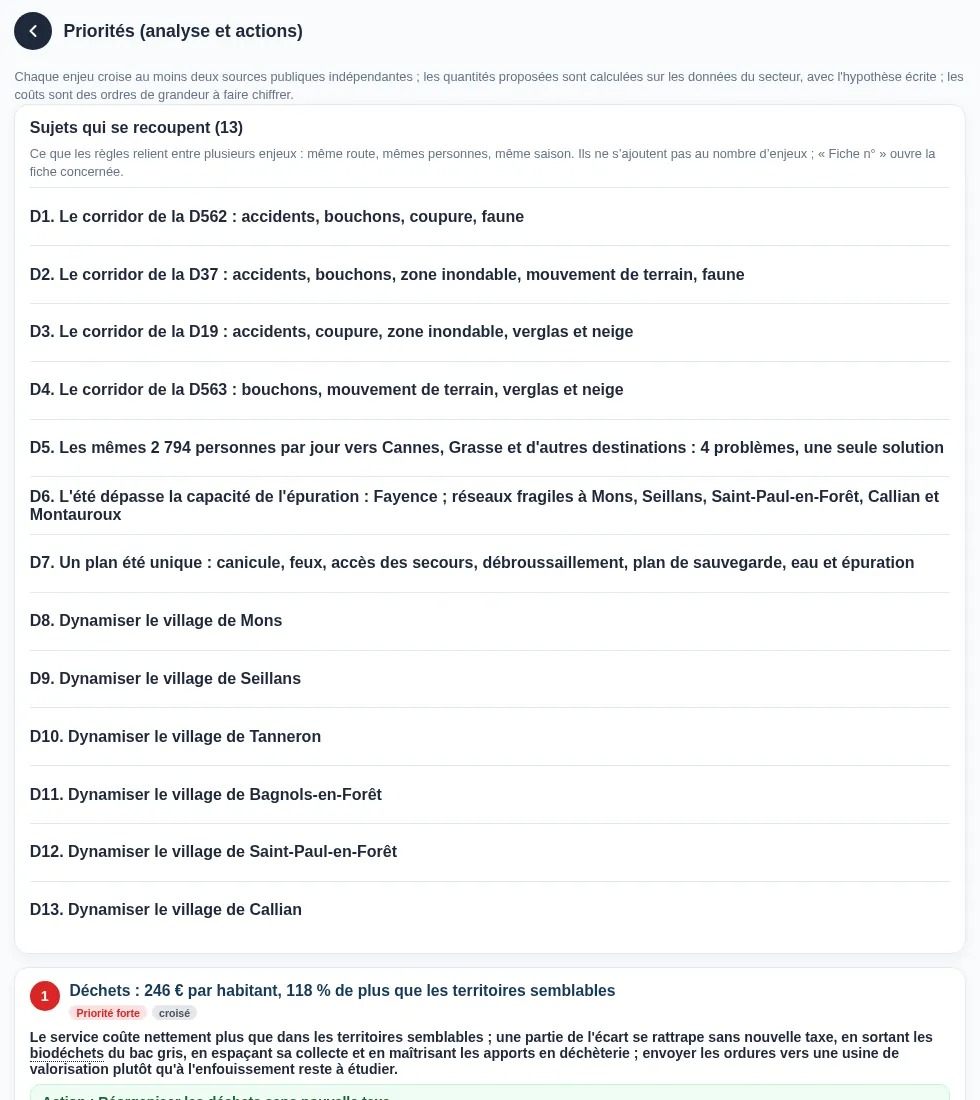
The Priorities (analysis and actions) view: at the top, thirteen overlapping topics (the corridor of the D562, D37, D19 and D563; the same 2,794 people a day going to Cannes, Grasse and other destinations; summer exceeding wastewater capacity; a single summer plan; revitalising six villages), then issue no. 1 on waste, €246 per resident, high priority.
Overlapping topics are grouped at the top.

What Territoire does

Five things, for the area of your choice

An area that fits your needs

A municipality, a postcode, an inter-municipal body or a list of municipalities, urban or rural, up to 120 municipalities.

An assessment produced for you

About forty steps reading public sources, with progress shown. The result is dated and can be rerun in one click.

Cross-checked issues and an action plan

Each issue combines at least two sources. Each action has an owner, a timescale, a cost range, funding and an indicator.

A map over time

Layers you can show or hide, and a time slider: weekday, Saturday or Sunday, from 5 am to 11 pm.

A PDF report to present

Complete or limited to the topics you choose: summary for decision-makers, action plan, issue sheets, map and sources.

Who it is for

Designed first for municipalities

Municipalities

Elected officials, town clerks, chief executives: a figures-based overview to present to the council, and sized actions.

Inter-municipal bodies

Mobility, waste, water networks and hazards across all member municipalities, one by one.

Departments, Regions, State, emergency services

Accident-prone roads, road closures and diversions, emergency access times.

Insurers

Recognised natural disasters, flood zones crossed, road safety, from one area to another.

Estate agents, developers, notaries

Sale prices, authorised housing, network capacity and hazards for an area.

Most common questions

Seven uses, one page each

Mobility assessment

How residents get around, where accidents happen, who has neither a car nor a bus.

The mobility assessment

Road closure contingency plan

Who is affected if the main road is closed, where to divert, and the contingency plan.

Road closures

Waste with no new tax

Your cost per resident compared, the law, and costed scenarios to bring it down.

Waste

Water: drought and leaks

Will your water last the summer, what leaks cost, where individual sanitation stands.

Water

Track a contract or programme

Actions, calculated targets, grants not to lose and an annual review, for a water and climate contract or another plan.

Contracts and programmes

Simplified mobility plan

Residents' survey, measured car-pooling, evaluated trials and a draft document.

The mobility plan

Sources and method

Where each figure comes from, what is measured, what is estimated, and what public data cannot tell.

Sources

Demo

Try the demo

An online demo opens an example assessment, its map, its simulators, an example project and example events. It is reserved for French public bodies: municipalities, inter-municipal bodies, departments, regions, syndicates, public establishments and State services.

Enter your work email address: it is checked against the official directory of the French administration, then you receive a code by email. Access lasts one month. The demo is read-only: nothing you do in it is saved. The tool is in French.

Try the demo

Proof by example

A real example: Pays de Fayence (Var, France)

30,664
residents in the 9 municipalities (INSEE census)
88.6%
of workers drive to work (INSEE)
70
injury accidents recorded by the police over five years, 86% of them serious or fatal (ONISR)
€246
per resident per year for waste, against €113 for similar areas (ADEME)

What the example shows

The assessment of the nine rural municipalities of Pays de Fayence, produced on 11 October 2026 from public data only, brings out 35 cross-checked issues, 13 of them high priority, and five road closure scenarios with their contingency plans. The full report runs to more than 180 pages.

See the example in detail · Sources and method

Pricing

A simple price, based on the size of your local authority

The same tool for everyone; only the price changes with size. For comparison, a simplified mobility plan study carried out by a consultancy cost between €36,200 and €89,575 in 19 French public contracts awarded between 2021 and 2023. Territoire does not replace such a study: it prepares its baseline assessment. The tool is in French and covers France only.

Under 10,000 residents

€125 excl. VAT per month, per block

That is €1,500 excl. VAT per year. Setting up your organisation: €500 excl. VAT, once.

  • An assessment of your area, rerun whenever you wish
  • Map, simulators and action plan
  • PDF reports, complete or limited to the topics you choose
  • Monitoring every 30 days, and an email if an alert appears or gets worse
Request a demo

10,000 to 49,999 residents

€300 excl. VAT per month, per block

That is €3,600 excl. VAT per year. Setting up your organisation: €1,500 excl. VAT, once.

  • An assessment of your area, rerun whenever you wish
  • Map, simulators and action plan
  • PDF reports, complete or limited to the topics you choose
  • Monitoring every 30 days, and an email if an alert appears or gets worse
Request a demo

50,000 to 149,999 residents

€800 excl. VAT per month, per block

That is €9,600 excl. VAT per year. Setting up your organisation: €3,000 excl. VAT, once.

  • An assessment of your area, rerun whenever you wish
  • Map, simulators and action plan
  • PDF reports, complete or limited to the topics you choose
  • Monitoring every 30 days, and an email if an alert appears or gets worse
Request a demo

150,000 residents and more

On quote

A large local authority has its own needs: we prepare a quote.

  • An assessment of your area, rerun whenever you wish
  • Map, simulators and action plan
  • PDF reports, complete or limited to the topics you choose
  • Monitoring every 30 days, and an email if an alert appears or gets worse
Request a demo

From €125 to €800 excl. VAT per month depending on the size of the local authority, on quote above 150,000 residents. Setting up your organisation is paid once, for the whole organisation, whatever the number of blocks; then you add blocks as you need them (15% off from two blocks). Prices exclude VAT; VAT is added at the applicable rate when it is due. The population used is the municipal population published by INSEE (for an inter-municipal body: that of all its municipalities). One-year contract, renewable up to three times. One electronic invoice per quarter, for the quarter just ended, submitted through Chorus Pro (the French public invoicing portal); payment within 30 days. Offered by Challl, of which Ngento is a trade name. For a department, a region, a State service or a company, let us discuss it during the demo.

Frequently asked questions

Before you request a demo

Do I need to install anything?
No. Territoire is a module of Ngento, which runs in the browser on a computer or a phone.
Are the figures reliable?
They come from named public sources, with their dates. Each finding is marked “measured” (counted in a source) or “estimate” (a rule applied to the data, to be checked on the ground). A source that does not respond is reported, never counted as zero.
Does it work for a small rural municipality? For a city?
Yes. Wording, suggested solutions and funding adapt to the density of the area. The tool has been tested on the nine rural municipalities of Pays de Fayence (Var) and on two districts of Lyon.
Is the tool available in English?
No. Territoire and its reports are in French, and it covers France only.
How much does Territoire cost?
It depends on the size of the local authority: €125 excl. VAT per month under 10,000 residents, €300 from 10,000 to 49,999, €800 from 50,000 to 149,999, on quote above. Setting up your organisation is paid once, for all your blocks; from two blocks, 15% off. The contract lasts one year and is renewable up to three times. You receive one invoice per quarter, for the quarter just ended, through Chorus Pro. VAT is added at the applicable rate when it is due. Details are in the Pricing section and on the local authority pricing page.
Does the tool keep evolving?
Yes, regularly: new sources and new calculations are added. What it cannot do yet is stated in every report. With a subscription, it can also be connected to real-time traffic services and other tools reserved for public bodies, depending on the agreements the authority itself has made with those providers.

Request a demo

Tell us who you are and which area you are interested in. We will arrange a presentation of Territoire, on your own area if you wish, and answer your questions about access. Please note that the tool itself is in French and covers France only.

Challl (Ngento) uses your answers to arrange the demo, reply to your request and present the terms of access. They are kept for three years in our system, then deleted. To access them or have them erased: contact@challl.com. Our privacy policy.